

Last Updated on January 19, 2026 by Admin
The construction industry is experiencing an unprecedented technological transformation. With the global construction technology market projected to reach $30.28 billion by 2034 (growing at a remarkable 16.8% CAGR), professionals who combine construction expertise with tech skills are commanding premium salaries and enjoying exceptional career growth.
ConstructionCareerHub App is LIVE — built ONLY for construction careers. Don’t apply with a weak resume.
Get ATS-ready Resume Lab + Interview Copilot + Campus Placement Prep (resume screening, skill gaps, interview readiness) — in minutes & Other advanced features.
Explore Smarter Construction Career Tools →Quick check. Big impact. Start now.
Here’s the reality: the construction sector needs 349,000 new workers in 2026, according to the Associated Builders and Contractors, and technology-focused roles are among the hardest to fill. This skills gap represents a golden opportunity for engineers, technicians, and construction professionals ready to upskill in digital construction technologies.
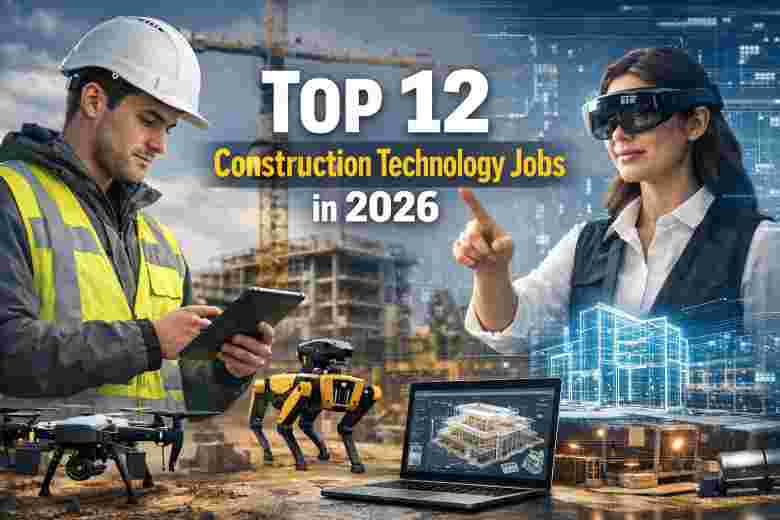
This comprehensive guide covers the top 12 construction technology jobs for 2026, including updated salary data, essential skills, career pathways, and the certifications that will set you apart in a competitive market.
Table of Contents
Construction Technology Market Overview 2026
The construction technology sector has reached a critical inflection point. Multiple market research reports confirm explosive growth:
- Market Size (2025): $5.66-$7.26 billion, depending on measurement scope (Mordor Intelligence)
- Projected Growth: Expected to reach $30.28 billion by 2034 at 16.8% CAGR (Cervicorn Consulting)
- Global Construction Market: $12.1 trillion in 2025, projected to reach $16-17 trillion by 2030 (Buildern)
- Construction Software Market: Projected to grow to $21.03 billion by 2032
According to Deloitte’s 2026 Engineering and Construction Industry Outlook, the industry needs 499,000 new workers in 2026 (up from 439,000 in 2025), with technology roles commanding the highest premiums due to acute shortages in specialized trades like data center construction and AI infrastructure projects.
Key Market Drivers
Several factors are accelerating construction technology adoption:
- Labor Shortages: 92% of construction firms report difficulty finding qualified workers.
- BIM Mandates: Government requirements for Building Information Modeling on public projects in Singapore, Poland, Dubai, and Hong Kong
- AI Data Center Boom: Massive investment in AI infrastructure is driving demand for specialized construction technology professionals
- Sustainability Requirements: ESG-linked financing requiring digital carbon tracking in construction
- Productivity Demands: Rising material costs and labor expenses are forcing automation adoption
Top 12 Construction Technology Jobs for 2026
The following roles represent the highest-demand, highest-paying positions in construction technology. Salary data is compiled from Glassdoor, ZipRecruiter, PayScale, and Salary.com as of January 2026.
Note: Actual salaries vary significantly based on experience, location, company size, and specific project requirements. Metro areas like San Francisco, New York, and Washington, D.C. typically pay 15-25% above national averages.
1. Building Information Modeling (BIM) Manager
A BIM Manager leads the implementation of BIM technology across construction projects, ensuring seamless collaboration between architects, engineers, and contractors. They oversee 3D model development, establish data standards, coordinate clash detection, and manage digital workflows throughout the project lifecycle.
Key Responsibilities:
- Developing and enforcing BIM execution plans (BEP) aligned with ISO 19650 standards
- Managing federated models and coordinating multi-disciplinary teams
- Conducting clash detection and resolution using Navisworks or similar tools
- Training staff on Autodesk Revit, BIM 360, and other platforms
- Ensuring Level of Development (LOD) specifications are met
Salary (USA 2026):
- Entry Level: $65,000 – $76,000
- Mid-Career: $91,500 – $98,500
- Senior/Lead: $124,000 – $161,000
- National Average: $91,566 – $126,231
Salary (India): ₹8,00,000 – ₹18,00,000 per year
Essential Skills: Autodesk Revit, Navisworks, BIM 360, ISO 19650, Project Management, Team Leadership
Recommended Courses:
- Construction Project Management by Columbia University (Coursera)
- Building Smarter: BIM in Practice Specialization (Coursera)
- BIM for Construction by Purdue University (edX)
2. IoT (Internet of Things) Architect
An IoT Architect designs and implements connected sensor networks for construction projects. They integrate smart devices, develop real-time monitoring systems for equipment tracking, safety compliance, energy management, and predictive maintenance across job sites.
Key Responsibilities:
- Designing IoT infrastructure for construction site monitoring
- Integrating sensors for equipment tracking, environmental monitoring, and worker safety
- Developing data pipelines from edge devices to cloud platforms
- Creating dashboards for real-time project intelligence
- Ensuring cybersecurity compliance for connected systems
Salary (USA 2026):
- Entry Level: $91,000 – $115,000
- Mid-Career: $128,756 – $145,963
- Senior/Lead: $166,000 – $200,000+
- Top Earners: $180,000 – $260,000
Salary (India): ₹15,00,000 – ₹30,00,000 per year
Essential Skills: Cloud Architecture (AWS/Azure), Python, Data Analytics, Network Security, Sensor Integration, Edge Computing
Recommended Courses:
3. Construction Drone Pilot/Operator
Drone Pilots use unmanned aerial vehicles (UAVs) to capture aerial imagery, perform site surveys, conduct safety inspections, and monitor construction progress. The global drone services market is projected to reach $213.87 billion by 2032, growing at 31.1% CAGR.
Key Responsibilities:
- Planning and executing drone flights for site documentation
- Creating orthomosaic maps and 3D terrain models using photogrammetry
- Conducting thermal imaging inspections for building envelope analysis
- Performing LiDAR scanning for topographic surveys
- Ensuring FAA Part 107 compliance and safety protocols
Salary (USA 2026):
- Entry Level (General): $50,000 – $65,000
- Construction Specialist: $71,000 – $95,000
- LiDAR/Mapping Specialist: $90,000 – $120,000
- Advanced (BVLOS Operations): $85,000 – $175,000
Salary (India): ₹4,00,000 – ₹12,00,000 per year
Essential Skills: FAA Part 107 Certification, Photogrammetry, LiDAR, DJI/Autel platforms, Pix4D, DroneDeploy, GIS Software
4. Virtual Design and Construction (VDC) Coordinator
VDC Coordinators manage the integration of virtual design processes into construction workflows. They bridge the gap between design intent and field execution by coordinating 4D/5D simulations, prefabrication planning, and digital twin development.
Key Responsibilities:
- Coordinating virtual design and construction planning sessions
- Managing 4D construction sequencing and scheduling simulations
- Facilitating model-based quantity takeoffs and cost estimation
- Developing prefabrication and modular construction workflows
- Supporting field teams with model access via tablets and mobile devices
Salary (USA 2026):
- Entry Level: $65,000 – $80,000
- Mid-Career: $85,000 – $105,000
- Senior: $110,000 – $135,000
Salary (India): ₹7,00,000 – ₹15,00,000 per year
Essential Skills: Autodesk Revit, Navisworks, Synchro Pro, Primavera P6, Lean Construction, IPD (Integrated Project Delivery)
Recommended Courses:
5. AR/VR (Augmented/Virtual Reality) Specialist
AR/VR Specialists develop immersive experiences for construction planning, design review, safety training, and client presentations. They create virtual walkthroughs, mixed-reality coordination sessions, and interactive training simulations.
Key Responsibilities:
- Creating immersive VR walkthroughs for design review and client presentations
- Developing AR overlays for on-site model comparison and installation guidance
- Building safety training simulations using Unity or Unreal Engine
- Integrating BIM models with AR/VR platforms (HoloLens, Meta Quest)
- Supporting quality assurance through mixed-reality inspection tools
Salary (USA 2026):
- Entry Level: $70,000 – $85,000
- Mid-Career: $95,000 – $125,000
- Senior/Lead: $130,000 – $165,000
Salary (India): ₹10,00,000 – ₹22,00,000 per year
Essential Skills: Unity, Unreal Engine, 3ds Max, Blender, Microsoft HoloLens, BIM integration, C#/C++
6. Construction Data Analyst
A Construction Data Analyst leverages data from multiple sources—BIM models, IoT sensors, project management systems, and historical databases—to provide actionable insights for better decision-making, cost control, and schedule optimization.
Key Responsibilities:
- Developing dashboards using Power BI or Tableau for project KPIs
- Performing predictive analytics for cost and schedule forecasting
- Mining historical project data to identify efficiency opportunities
- Creating reports for executive decision-making
- Supporting machine learning models for risk assessment
Salary (USA 2026):
- Entry Level: $60,000 – $72,000
- Mid-Career: $78,208 – $97,713
- Senior: $105,000 – $135,000
Salary (India): ₹6,00,000 – ₹14,00,000 per year
Essential Skills: SQL, Python, Power BI, Tableau, Excel (Advanced), Statistical Analysis, Construction Domain Knowledge
Recommended Courses:
7. Construction Robotics Technician
A Construction Robotics Technician installs, programs, maintains, and troubleshoots robotic systems used on construction sites, including autonomous equipment, robotic bricklayers, rebar-tying robots, and 3D concrete printers.
Key Responsibilities:
- Installing and calibrating robotic construction equipment
- Programming robotic systems for specific construction tasks
- Performing preventive maintenance and repairs
- Training operators on safe robotic equipment use
- Troubleshooting hardware and software issues on-site
Salary (USA 2026):
- Entry Level: $55,000 – $70,000
- Mid-Career: $75,000 – $95,000
- Senior/Specialist: $100,000 – $125,000
Salary (India): ₹5,00,000 – ₹12,00,000 per year
Essential Skills: PLC Programming, Robotics Systems, Mechanical Troubleshooting, Electronics, Safety Protocols, Preventive Maintenance
8. 3D Printing Specialist (Additive Manufacturing)
A 3D Printing Specialist focuses on implementing additive manufacturing technologies for construction applications, including concrete 3D printing for housing, prefabricated building components, and rapid prototyping. Virginia Housing recently invested $1.1 million in 3D printing technology to construct 10 affordable homes by 2026.
Key Responsibilities:
- Operating and maintaining large-format construction 3D printers
- Developing printable concrete mix designs and material specifications
- Creating digital models optimized for additive manufacturing
- Collaborating with structural engineers on print-ready designs
- Quality testing printed components for structural integrity
Salary (USA 2026):
- Entry Level: $55,000 – $70,000
- Mid-Career: $75,000 – $95,000
- Senior/Lead: $100,000 – $130,000
Salary (India): ₹5,50,000 – ₹12,00,000 per year
Essential Skills: CAD/CAM Software, Materials Science, Gantry Systems, Concrete Mix Design, Quality Control
9. Geospatial Technician / GIS Specialist
Geospatial Technicians work with Geographic Information Systems (GIS) and remote sensing technologies to gather, analyze, and visualize spatial data for site selection, terrain analysis, utility mapping, and infrastructure planning.
Key Responsibilities:
- Creating and maintaining GIS databases for construction projects
- Performing topographic surveys using GPS/GNSS equipment
- Analyzing terrain data for site suitability assessments
- Integrating geospatial data with BIM models
- Supporting environmental impact assessments with spatial analysis
Salary (USA 2026):
- Entry Level: $48,000 – $58,000
- Mid-Career: $62,000 – $78,000
- Senior/Lead: $85,000 – $110,000
Salary (India): ₹4,00,000 – ₹10,00,000 per year
Essential Skills: ESRI ArcGIS, QGIS, GPS/GNSS Equipment, Remote Sensing, AutoCAD Civil 3D, Spatial Analysis
Recommended Courses:
10. Construction Technology Specialist
A Construction Technology Specialist evaluates, implements, and supports emerging technologies across construction organizations. They serve as the bridge between IT departments and field operations, ensuring new technologies deliver measurable value.
Key Responsibilities:
- Researching and evaluating new construction technologies for adoption
- Developing technology implementation roadmaps and business cases
- Training field teams on new software and tools
- Supporting digital transformation initiatives across projects
- Measuring ROI and technology adoption metrics
Salary (USA 2026):
- Entry Level: $60,000 – $75,000
- Mid-Career: $80,000 – $100,000
- Senior/Director: $110,000 – $145,000
Salary (India): ₹6,00,000 – ₹14,00,000 per year
Essential Skills: Project Management, Change Management, Technology Evaluation, Training Development, Stakeholder Management
11. Digital Twin Engineer
Digital Twin Engineers create and maintain virtual replicas of physical construction assets throughout their lifecycle. This emerging role combines BIM, IoT, and data analytics to enable real-time monitoring, predictive maintenance, and operational optimization for buildings and infrastructure.
Key Responsibilities:
- Developing digital twin models from BIM and as-built data
- Integrating real-time sensor data for live asset monitoring
- Creating predictive maintenance algorithms for facility operations
- Supporting owner decision-making through scenario simulations
- Managing digital handover from construction to operations
Salary (USA 2026):
- Entry Level: $75,000 – $90,000
- Mid-Career: $100,000 – $125,000
- Senior/Lead: $140,000 – $175,000
Salary (India): ₹12,00,000 – ₹25,00,000 per year
Essential Skills: BIM, IoT Integration, Azure Digital Twins, Bentley iTwin, Python, Data Visualization, Facility Management
12. AI/Machine Learning Engineer (Construction)
AI/ML Engineers in construction develop intelligent systems for project risk prediction, automated schedule optimization, safety monitoring, quality inspection, and resource allocation. This specialized role combines software engineering expertise with deep construction domain knowledge.
Key Responsibilities:
- Building machine learning models for project risk prediction
- Developing computer vision systems for safety and quality inspection
- Creating NLP tools for contract analysis and RFI processing
- Implementing AI-powered scheduling and resource optimization
- Deploying models to production environments on construction platforms
Salary (USA 2026):
- Entry Level: $95,000 – $120,000
- Mid-Career: $135,000 – $165,000
- Senior/Lead: $175,000 – $250,000+
Salary (India): ₹18,00,000 – ₹45,00,000 per year
Essential Skills: Python, TensorFlow/PyTorch, Computer Vision, NLP, Cloud ML (AWS SageMaker, Azure ML), MLOps, Construction Domain Knowledge
Construction Technology Salary Comparison Table 2026
| Job Role | Entry Level (USA) | Mid-Career (USA) | Senior (USA) | India Range |
|---|---|---|---|---|
| IoT Architect | $91,000 – $115,000 | $128,000 – $146,000 | $166,000 – $200,000+ | ₹15-30 LPA |
| AI/ML Engineer (Construction) | $95,000 – $120,000 | $135,000 – $165,000 | $175,000 – $250,000 | ₹18-45 LPA |
| Digital Twin Engineer | $75,000 – $90,000 | $100,000 – $125,000 | $140,000 – $175,000 | ₹12-25 LPA |
| AR/VR Specialist | $70,000 – $85,000 | $95,000 – $125,000 | $130,000 – $165,000 | ₹10-22 LPA |
| BIM Manager | $65,000 – $76,000 | $91,500 – $98,500 | $124,000 – $161,000 | ₹8-18 LPA |
| VDC Coordinator | $65,000 – $80,000 | $85,000 – $105,000 | $110,000 – $135,000 | ₹7-15 LPA |
| Drone Pilot (Construction) | $50,000 – $65,000 | $71,000 – $95,000 | $90,000 – $175,000 | ₹4-12 LPA |
| Construction Data Analyst | $60,000 – $72,000 | $78,000 – $97,000 | $105,000 – $135,000 | ₹6-14 LPA |
| Construction Robotics Tech | $55,000 – $70,000 | $75,000 – $95,000 | $100,000 – $125,000 | ₹5-12 LPA |
| 3D Printing Specialist | $55,000 – $70,000 | $75,000 – $95,000 | $100,000 – $130,000 | ₹5.5-12 LPA |
| Construction Tech Specialist | $60,000 – $75,000 | $80,000 – $100,000 | $110,000 – $145,000 | ₹6-14 LPA |
| Geospatial Technician | $48,000 – $58,000 | $62,000 – $78,000 | $85,000 – $110,000 | ₹4-10 LPA |
Data sources: Glassdoor, ZipRecruiter, PayScale, Salary.com (January 2026). LPA = Lakhs Per Annum.
Essential Skills & Certifications for 2026
Employers increasingly prioritize candidates with validated skills and industry-recognized certifications. Here are the most valuable credentials for construction technology roles:
BIM & Digital Construction Certifications
- Autodesk Certified Professional (Revit) – Industry standard for BIM software proficiency
- buildingSMART Professional Certification – Validates openBIM competency
- AGC Certificate of Management – Building Information Modeling (CM-BIM) – Project-focused BIM management
- RICS BIM Manager Certification – Global recognition for BIM leadership
Drone & Surveying Certifications
- FAA Part 107 Remote Pilot Certificate – Required for commercial drone operations in the USA
- Thermography Certification (FLIR) – Essential for building envelope inspections
- ASPRS Certified Mapping Scientist – Advanced geospatial credentials
Project Management & Technology
- PMP (Project Management Professional) – Universal project management credential
- Lean Construction Institute (LCI) Certification – Lean methodology expertise
- AWS Certified Solutions Architect – Valuable for IoT and cloud-based construction platforms
Top Construction Technology Courses (2026)
Upskill with these highly-rated programs from leading platforms:
| Course | Platform | Focus Area |
|---|---|---|
| Building Smarter: BIM in Practice | Coursera (L&T EduTech) | BIM Implementation |
| Construction Project Management | Coursera (Columbia University) | Project Management |
| Sustainable Buildings, Green Construction | Coursera | Sustainability |
| Sustainable Construction Management | edX | Sustainability |
| The Construction Industry: The Way Forward | Coursera | Industry Trends |
| Renewable Energy Technology Fundamentals | Coursera | Energy/Sustainability |
| Ethics, Technology and Engineering | Coursera | Professional Ethics |
Job Outlook & Industry Trends for 2026 and Beyond
The construction technology job market remains exceptionally strong, driven by converging factors:
Labor Shortage Creating Tech Opportunities
According to the latest data from Associated Builders and Contractors:
- 349,000 new workers needed in 2026 (down from 439,000 in 2025 due to economic cooling)
- 92% of firms report difficulty finding qualified workers
- 45% of project delays are attributed to workforce shortages
- 41% of the current workforce will retire by 2031, according to NCCER
- $10.8 billion annual impact from skilled labor shortage in residential construction alone (NAHB)
This persistent shortage is accelerating technology adoption as companies seek to do more with fewer workers.
Emerging Technology Trends
Key technologies shaping construction jobs in 2026:
- AI-Powered Project Management: Predictive analytics for schedule optimization and risk management
- Autonomous Equipment: Self-driving excavators and delivery robots for material handling
- Computer Vision: Real-time safety monitoring and quality inspection systems
- Generative Design: AI-assisted design optimization for structural efficiency
- Blockchain Smart Contracts: Automated payment processing and supply chain verification
- Exoskeletons: Wearable robotics to enhance worker productivity and reduce injuries
Regional Market Insights
Construction technology job growth varies by region:
- USA: Strongest growth in data center construction (AI infrastructure), advanced manufacturing, and healthcare
- India: 15.7% CAGR growth expected through 2025, with major demand from Smart Cities Mission projects
- Middle East: Dubai and Saudi Arabia mandating BIM on all major public projects
- Europe: Sustainability-driven technology adoption with ISO 19650 becoming standard
How to Break Into Construction Technology
Whether you’re a construction professional looking to upskill or a tech worker seeking a new industry, here’s a strategic approach:
For Construction Professionals
- Start with BIM: Learn Autodesk Revit through online courses and hands-on practice
- Build Data Skills: Master Excel first, then learn Power BI or Tableau for visualization
- Get Certified: Pursue Autodesk certifications and consider PMP for management roles
- Volunteer for Tech Projects: Offer to pilot new technologies on your current projects
- Network: Join organizations like AEC associations and attend ConTech conferences
For Technology Professionals
- Learn Construction Fundamentals: Understand project lifecycle, stakeholders, and common challenges
- Focus on Domain-Specific Applications: Apply your tech skills to construction use cases
- Target ConTech Companies: Procore, Autodesk, Trimble, and startups are actively hiring
- Consider Consulting: Many firms need tech expertise but can’t justify full-time hires
- Build a Portfolio: Create sample dashboards, models, or prototypes demonstrating construction applications
Frequently Asked Questions
What is construction technology?
Construction technology encompasses the innovative tools, software, equipment, and methodologies used to improve efficiency, safety, and sustainability in the construction industry. This includes BIM software, drones, robotics, IoT sensors, AI/ML applications, 3D printing, and digital collaboration platforms.
What are the highest-paying construction technology jobs?
The highest-paying construction technology roles in 2026 are IoT Architects ($128,000-$200,000+), AI/ML Engineers ($135,000-$250,000), and Digital Twin Engineers ($100,000-$175,000). Senior BIM Managers and AR/VR Specialists at major firms can also command salaries exceeding $150,000.
What skills do I need for construction technology jobs?
Core skills include proficiency in BIM software (Revit, Navisworks), data analysis (SQL, Python, Power BI), understanding of construction processes, and strong communication abilities. Specialized roles require additional expertise in IoT platforms, machine learning, drone operations, or robotics systems.
Is a degree required for construction technology jobs?
While many positions prefer candidates with degrees in civil engineering, construction management, computer science, or related fields, industry certifications and demonstrated skills can substitute for formal education in many cases. Autodesk certifications, FAA Part 107, and professional credentials carry significant weight with employers.
What is the job outlook for construction technology careers?
The job outlook is exceptionally strong. The construction technology market is growing at 16.8% annually, while the broader construction industry faces a persistent labor shortage requiring 349,000+ new workers per year. Technology professionals with construction domain knowledge are in high demand across all major markets.
How do I transition from traditional construction to construction technology?
Start by learning BIM fundamentals through online courses, then expand into data analysis and visualization tools. Volunteer for technology-focused projects within your current role, pursue relevant certifications, and network with ConTech professionals. Your construction experience is a valuable asset that pure technologists often lack.
Final Thoughts
The construction industry’s labor challenges and technology adoption are creating unprecedented career opportunities. As the sector embraces technological advancements, professionals who combine construction domain expertise with digital skills will be positioned for long-term success.
The top 12 construction technology jobs highlighted in this guide represent diverse career paths with competitive salaries and strong growth trajectories. Whether you’re interested in BIM management, IoT architecture, drone operations, or AI engineering, the construction technology sector offers rewarding opportunities for those ready to shape the future of construction.
By staying informed about emerging trends, continuously developing skills, and pursuing relevant certifications, you can position yourself for success in this rapidly evolving industry. The integration of technology in construction enhances efficiency, sustainability, and safety while creating challenging and rewarding career opportunities for those willing to adapt and grow.
Related Posts:
- Civil Engineering Vs. Mechanical Engineering: Major Differences
- What is Civil Engineering Technology?
- What is a Construction Worker? Roles & Responsibilities
- Digital Construction | What Is Digital Construction Management?
- Green Construction Technology Innovations
- Construction Planning and Scheduling
